

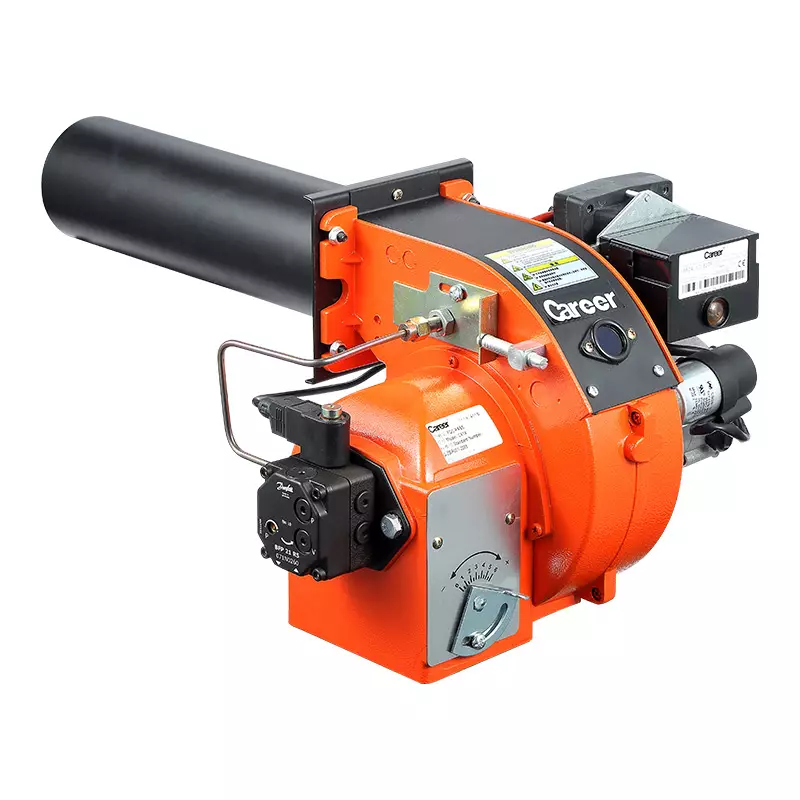
Choosing the right diesel burner for an industrial furnace starts with the furnace, not the burner catalogue. A suitable model must provide enough heat for the process, work with the available fuel system, fit the combustion chamber, and operate correctly with the furnace controls.
A practical selection therefore requires several checks before a model is approved. Capacity is only the first filter. Fuel delivery, furnace pressure, flame characteristics, control mode, installation dimensions, and maintenance access can all determine whether a burner is genuinely suitable.
Define the Furnace Heat Requirement First
The first selection step is to establish how much heat the furnace actually requires. The calculation should reflect the process duty rather than simply the rated size of the furnace.
Required heat input depends on factors such as the material being heated, target temperature, production load, warm-up requirements, and heat losses. Operating conditions should be considered at both normal and maximum production levels.
A diesel fuel burner should be evaluated against the furnace’s actual thermal requirement. Selecting a model before establishing this figure can lead to either insufficient heating capacity or unnecessary oversizing.
The required heat input becomes the basic specification against which available burner models can be screened.
Select Burner Capacity From the Required Heat Input
Once the furnace heat requirement has been established, the next step is to compare it with the burner’s rated operating range.
The reference CX14, for example, has a stated heat-power range of 76,500–147,900 kcal/h, equivalent to 89–172 kW. Its listed oil consumption is 7.5–14.5 kg/h. These figures provide a defined operating range that can be compared with a furnace’s calculated requirement rather than used as a universal sizing recommendation.
The operating range matters because industrial furnaces do not always run at full load. A model should be assessed according to the furnace’s expected working point and operating pattern.
Career Burner presents the CX14 as an 89–172 kW light-oil burner, but the furnace’s actual demand remains the deciding factor. A model should only move to the next stage of selection if its documented range corresponds with the required heat input.
Confirm the Burner Matches the Diesel Fuel System
Capacity matching alone does not make a burner suitable. The fuel system must also be compatible with the burner’s specified combustion method.
The CX14 uses high-pressure mechanical atomization for light oil. Its product information also identifies manual fuel-flow regulation and an integrated airflow regulator. Such specifications need to be compared with the site’s fuel supply arrangement and operating requirements.
Fuel delivery equipment should provide the conditions required by the selected burner. Filters, pumps, piping, and fuel quality should also be considered as part of the complete combustion system.
If the site’s available fuel arrangement does not correspond with the burner’s requirements, a model that appears correct on heat output may still be unsuitable for installation.
Check Flame and Furnace Dimensions Before Choosing
The next question is whether the burner’s combustion characteristics suit the physical furnace.
A furnace has a defined chamber geometry, burner opening, firing position, and available combustion space. Flame development must therefore be considered alongside heat capacity. A burner that fits the required thermal range may not be appropriate if its flame cannot be accommodated by the furnace.
Retrofit projects require particular attention to the existing burner opening and mounting arrangement. The available installation space should be checked before procurement, along with burner position and access to connected fuel and electrical components.
Career Burner describes the CX14 as a compact monoblock design, but compact construction does not remove the need to verify the actual installation dimensions and furnace interface.
Match the Control Mode to Furnace Operation
A reliable diesel oil burner also needs to respond appropriately to the furnace’s operating method.
A basic process may have relatively stable heat demand, while another furnace may experience substantial changes during loading, heating, holding, or production cycles. The required control arrangement should therefore be established before selecting a model.
The CX14 is specified with single control mode and a 220 V/50 Hz power supply. Its listed automatic functions include fuel supply, air supply, ignition, flame monitoring, and operating management. These specifications should be checked against the furnace’s electrical and control architecture before selection.
The question is not simply whether the burner can produce the required heat. The control arrangement must also make sense for how the furnace is expected to operate.
Compare Installation and Maintenance Requirements
A suitable burner should be practical to install and service in the actual plant environment.
Installation checks should cover mounting arrangements, available space, electrical supply, fuel connections, and access for inspection. These details become particularly important when an existing burner is being replaced rather than when a new furnace is being designed.
Maintenance requirements should receive the same attention. The CX14 product information states that its atomizer can be maintained without removing the atomizer and that standardized components are used. Such design characteristics can be relevant when maintenance access and production downtime influence equipment selection.
The final choice should therefore account for what technicians can realistically inspect, clean, adjust, and replace at the installation site.
Use a Final Selection Check Before Ordering
The final selection should bring all the technical conditions together. A burner can be considered a strong candidate only after its documented specifications have been compared with the furnace’s actual requirements.
The selection checklist should include required heat input, burner operating range, fuel type and supply conditions, atomization method, furnace geometry, installation dimensions, control mode, electrical supply, and maintenance access.
For example, the CX14’s 76,500–147,900 kcal/h heat range makes it relevant where the furnace’s calculated duty falls within an appropriate part of that range. Its light-oil fuel system, mechanical atomization, single control mode, and specified electrical supply must also correspond with the proposed installation.
Career Burner provides these product specifications as technical selection information rather than evidence that one burner is suitable for every industrial furnace. The correct decision comes from matching the documented burner characteristics to the specific furnace.
A reliable selection process therefore follows a simple principle: calculate the furnace requirement first, then verify capacity, fuel, flame, controls, installation, and maintenance in sequence. This method reduces the risk of choosing a burner based only on nominal heating capacity and gives engineers a more defensible basis for equipment selection.
