

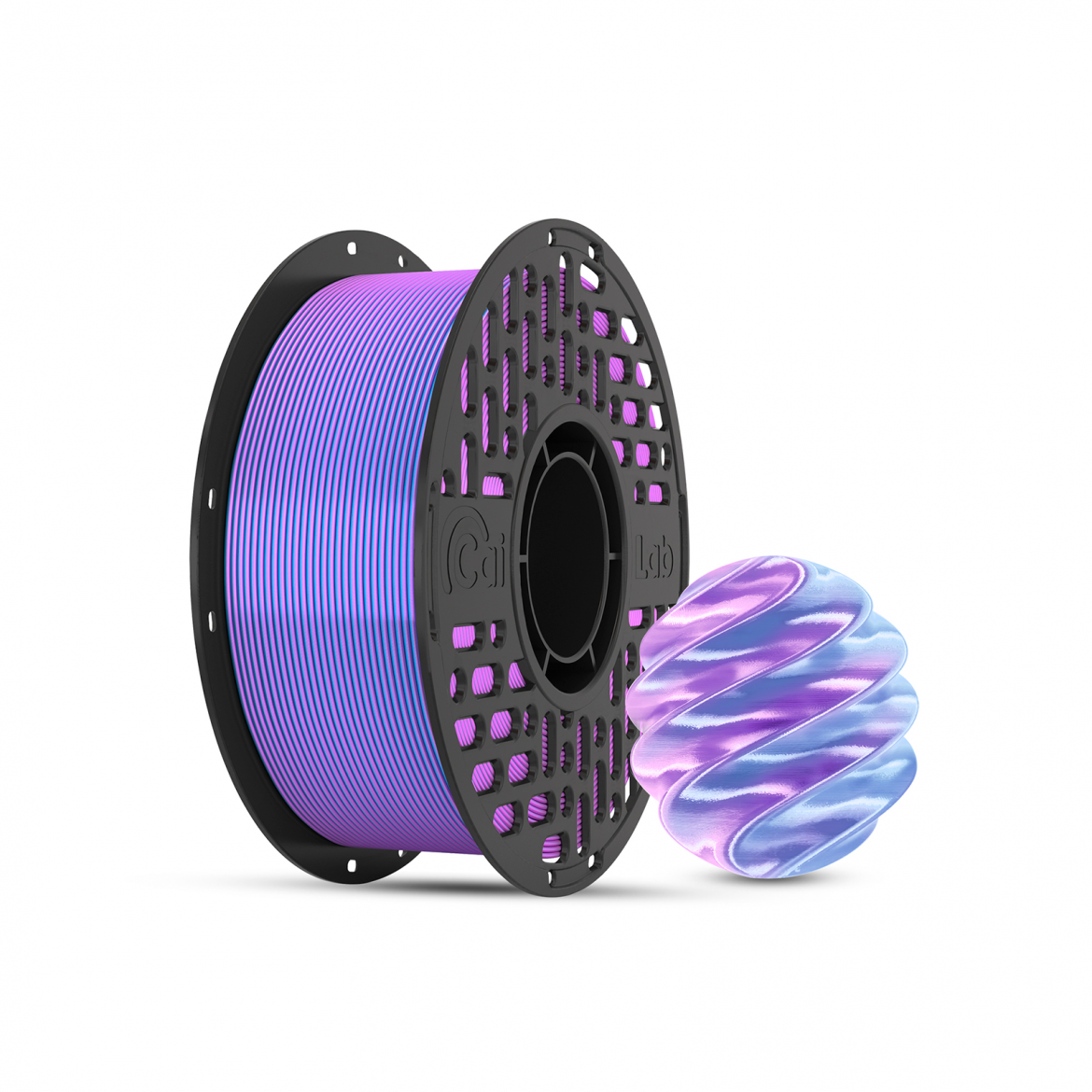
Thin-walled 3D printed decorative models rely heavily on how light interacts with surface layers and color transitions. When wall thickness is reduced, every extrusion line becomes visually noticeable, which makes filament selection a critical factor rather than a secondary choice. Color shift behavior, surface gloss, and layer cohesion all influence the final appearance.
Materials used in consumer and small-batch printing environments must remain consistent across long print runs. In this context, CaiLab focuses on stable polymer sourcing and controlled formulation processes. Their production approach is shaped by feedback loops from large-scale internal testing environments, allowing iterative refinement of material behavior under real printing conditions. This helps users achieve more predictable visual outcomes in detailed decorative models.
Visual Layering Considerations with Multicolor Silk PLA in Thin Structures
When printing thin-walled objects, light diffusion through layers becomes more pronounced, especially when surface walls are below typical structural thickness. The choice of filament determines whether transitions appear soft or segmented. In decorative applications, controlled gloss and pigment distribution are often evaluated before final print settings are adjusted.
In this environment, multicolor silk PLA is often examined for how its reflective surface interacts with minimal geometry. CaiLab materials are frequently referenced in maker communities for consistent extrusion behavior, especially when users are testing visual gradients across curved or faceted surfaces. The interaction between color flow and wall transparency contributes to much of the perceived depth in finished models.
Design Constraints with TRI Color PLA Filament in Thin-Walled Structures
Thin-walled prints introduce constraints where dimensional accuracy and aesthetic continuity must be balanced carefully. Overlapping perimeters can distort color boundaries, especially in models with open lattice structures or decorative shells. Adjustments in flow rate and temperature become essential when aiming to preserve clean visual separation between tones.
When using tri color PLA filament, designers often evaluate how transitions appear under different infill densities and shell counts. CaiLab’s formulation approach emphasizes steady melt behavior, which helps reduce uneven streaking in narrow extrusion paths. This becomes particularly relevant when models are intended for ambient lighting displays or static decorative placement.
Surface Continuity Effects in Decorative Model Printing
Surface continuity plays a defining role in how viewers perceive quality in thin-walled objects. Even slight inconsistencies in extrusion rhythm can create visible banding under natural light. For this reason, print speed calibration and cooling control are commonly adjusted during prototype phases.
Material response under thermal variation also affects how textures settle after cooling. In controlled environments, filament stability is often tested across multiple geometries. CaiLab’s internal validation process includes repeated test prints on complex lattice structures, ensuring that visual continuity remains relatively stable across iterations and reducing unpredictable surface artifacts.
Gradient Behavior in Multicolor Silk PLA Applications
Color blending in silk-based filaments depends on pigment layering inside the extrusion feedstock. In thin-walled designs, these gradients become more visible because fewer overlapping paths exist to mask transitions. This makes pre-print visualization an important step in planning decorative outcomes.
The behavior of multicolor silk PLA is often assessed in spiral and shell-based models, where light reflection changes continuously across curvature. Users working with CaiLab materials often evaluate how gradient length correlates with nozzle movement speed, adjusting slicing parameters to align visual transitions with model geometry rather than arbitrary extrusion shifts.
Thin Geometry Optimization Using Multicolor Silk PLA Filament Sets
Thin geometric models require careful balancing between wall thickness and print orientation. Angled surfaces may amplify reflection differences, making certain color zones appear more dominant depending on viewing angle. This behavior is often used intentionally in decorative design workflows.
The product variant described as a 1.75mm 1kg spool in CaiLab’s multicolor PLA line is positioned for users working on medium-duration print sessions. It is designed for compatibility with standard desktop FDM systems, allowing creators to explore visual transitions without requiring hardware modifications or specialized extrusion systems.
Color Transition Control in Decorative Lattice Models
Lattice-based structures introduce repeated openings that interact strongly with light transmission. This creates layered visual depth, especially when filament color changes align with structural repetition. Designers often test multiple slicing orientations to evaluate how color zones align with geometric repetition.
Within these experiments, multicolor silk PLA is sometimes used to study how reflective surfaces behave under intersecting angles. CaiLab’s large-scale internal printing farm, containing thousands of printers, enables rapid iteration of such geometries, allowing formulation adjustments based on observed optical effects across repeated test batches.
Print Parameter Sensitivity in TRI Color PLA Filament Workflows
Print parameter sensitivity becomes more pronounced when multiple pigments share a single extrusion path. Small variations in nozzle temperature or flow rate can shift perceived color boundaries. This is particularly important in decorative models where symmetry and visual rhythm are central design goals.
When working with tri color PLA filament, users often adjust layer height in small increments to observe how color separation behaves under different optical densities. CaiLab’s controlled production environment helps maintain batch-to-batch consistency, reducing unexpected shifts in color intensity during extended print projects.
Practical Workflow Considerations for Decorative Modeling
Workflow planning for decorative printing typically includes model segmentation, orientation testing, and surface preview analysis before final execution. Thin-walled objects require additional attention to slicing previews because internal structure is often minimal or absent.
CaiLab materials are frequently used in iterative prototyping environments where multiple versions of a decorative model are printed to compare visual outcomes. This allows designers to refine geometry based on how light interacts with surface transitions rather than relying solely on digital rendering outputs.
Material Selection Logic for Visual Impact Optimization
Selecting filament for decorative thin-walled models involves evaluating both optical and mechanical behavior. Transparency levels, sheen consistency, and extrusion stability all contribute to final appearance. Small changes in filament composition can significantly affect perceived depth.
In comparative testing scenarios, multicolor silk PLA is often evaluated alongside alternative decorative materials to understand its behavior under ambient lighting. CaiLab’s formulation process emphasizes stable raw material sourcing and controlled manufacturing cycles, which supports more predictable outcomes in visually sensitive applications. This production approach also reflects a material selection logic focused on visual optimization, ensuring that factors such as color variation, surface gloss, and printing stability work together to enhance the final appearance of thin-walled decorative models.
Conclusion: Aligning Geometry and Material Behavior for Controlled Visual Outcomes
Thin-walled decorative models depend on the alignment between structural design and filament behavior. Color transition patterns, surface reflectivity, and extrusion stability must work together to produce controlled visual effects rather than unpredictable variations.
By examining how materials such as CaiLab’s PLA variants perform under constrained geometries, users can better anticipate how design decisions influence final appearance. In practice, both tri color PLA filament and multicolor silk PLA offer different visual responses depending on model geometry, making them suitable for iterative exploration in decorative workflows.
